
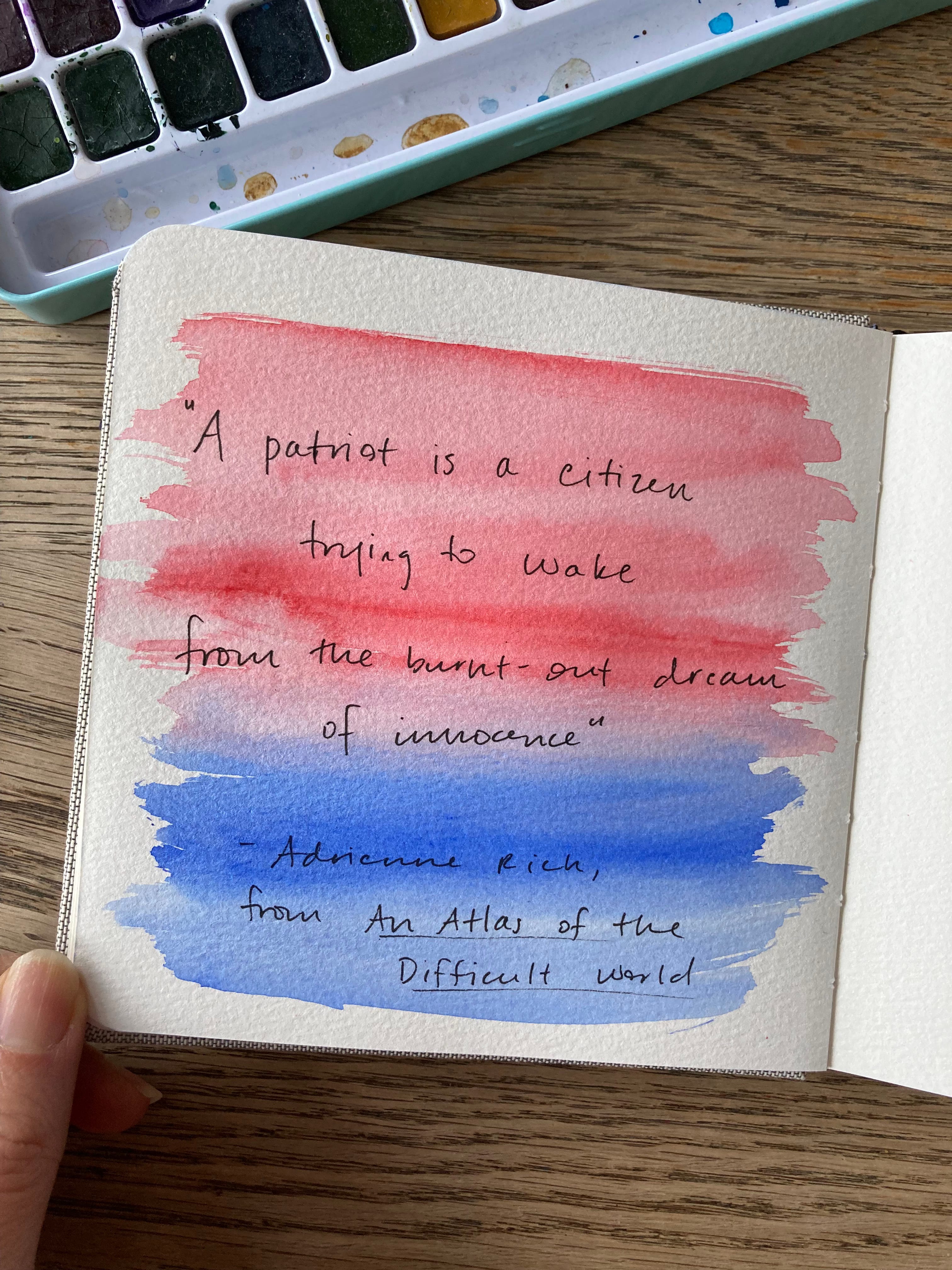
"bright unbearable reality"—
on force, impermanence, and the courage of fierce tenderness

I.
Somehow we are still slicing potatoes.
As I stood in my kitchen this week scrubbing starchy vegetables, slicing them in half then cutting each half into thin wedges for the pan, I felt the incongruity: threats and terror, global disorder, government-driven violence—and still, the children must eat.
Salt stings wounds and pleases the tongue. On my winter-cracked hands it burns, but sprinkled over potatoes roasted in high heat it delights. We sat around the table, lit the candles, said our prayers of thanks. We ate, and I felt the painful gift of it, all four of us together, all four of us safe.
II.
In November, I was honoured to give a talk about Simone Weil’s essay “The Iliad, or The Poem of Force.” You can watch it here, along with other talks hosted by the American Weil Society that are very much worth your while.
Weil’s argument in this essay, which she wrote while Nazis invaded her home country of France, has to do with mechanics of force: the way violent power circulates, the way militarization coopts its participants into something much bigger and more destructive than they can control. Mary McCarthy translated Weil’s essay into English in the wake of the atrocities of Hiroshima and Nagasaki, and it’s no wonder that it affected its readers so powerfully in the fall of 1945. They were contending with the horror of violent power we humans had come to wield and the ways it seems at points instead to wield us.
Offering an arrestingly original reading of the Iliad, Weil writes of how force “sweeps away,” “blinds,” and even “deforms” humans who think they are exercising power over others. I think I heard this deformity in the epithet muttered by the ICE agent who killed Renee Good after he shot her body three times. I think I saw how he was swept away, claiming to fear this gentle-voiced woman with a dog in her back seat and stuffed animals in the glovebox. I think I witnessed how blind he was to her humanity.
Watching the videos of so many others taken, beaten, threatened, disappeared, bearing witness to these stories of immigrants—legal and otherwise—and citizens, most of them Brown and Black, threatened and afflicted, I think I see how force distorts and corrupts. These masked agents are acting at the behest of a violence that exceeds them, a power that authorizes their worst impulses. For Weil, a soldier becomes a “tool” of force, “possessed by war.” To have this kind of power and not use it to harm others indiscriminately, she argues, would require “superhuman virtue.”
But what’s remarkable about the Homeric poem, Weil asserts, what we so often forget, is that those who think they have all power are also vulnerable—in fact, quiet fear of their own vulnerability is part of what compels them to act so violently. There is no such thing as absolute immunity: the tables turn. Everyone suffers. Legal protection doesn’t keep a cancer from simmering in your bone marrow. All the money in the world won’t keep you from an eventual death, desperate anti-aging efforts notwithstanding. Holding a gun in your hand and using a preschooler as deportation bait might make you feel invincible for a moment, sir, but we who are watching with open hearts see that underneath that big vest and mask, you’re just a tiny, pitiful, terrified human.
III.
I mentioned the talk I’d given for the Weil Society to one of my colleagues, and he asked if I’d read Alice Oswald’s 2011 book-length poem Memorial: A Version of Homer’s Iliad. I hadn’t, but I checked it out of the library right away, and once I sat down to read it I couldn’t stop until I got to the end. The poem is 81 pages long, not a translation of the Iliad’s story, according to Oswald, but of its “atmosphere.” It begins with a list of 200 names, one after the other, all capitalized, without comment—the names of those who die in the epic.
In moving lyric and a kind of incantatory or liturgical practice of repetition, the pages that follow narrate their imagined deaths and some of the effects of those deaths in the world. The poetry relies on simile and nature imagery, much like the Homeric original. It is often arrestingly beautiful:
Like when they’re cutting ash poles in the hills
The treetops fall as soft as cloth
In a way, Oswald’s book feels like a literary manifestation of Weil’s interpretation, an insistence on the humanity of every human caught up in the violent war, a tenderness toward all the losses, regardless of the side they’re on or their status in life:
BATHYCLES and LAOGONUS
One rich man one a priest
Both became earth
POLYDORUS is dead who loved running
Now somebody has to tell his father
This is what Weil calls the remarkable “equity” of the Iliad, its insistence on treating with compassion all human suffering and death. Oswald’s poem bears witness, and we who read it bear witness. Those initial eight pages of capitalized names are like any memorial to fallen soldiers or mass atrocities like the Holocaust: they remind us of both what was and what ought not ever be again.
Or they should.
Oswald writes in her introduction that “ancient critics praised [the Iliad’s] ‘enargeia,’ which means something like ‘bright unbearable reality.’” It tells the truth. Oswald seeks to do the same:
Grief is black it is made of earth
It gets into the cracks in the eyes
she writes, and later:
God rains on the roof hammering his fist down
He has had enough of violent smiling men
IV.
At the very end of her essay, Weil argues that a true cultural transformation could occur if we could “learn that there is no refuge from fate, learn not to admire force, not to hate the enemy, nor to scorn the unfortunate.” So often these days the current US administration vies for absolute power, even beyond the bounds of the rule of law, openly admiring force. So often we blame those who suffer for their own suffering—as when people I know and some I even love insist everyone ICE is deporting or hurting or killing must deserve the treatment they receive.
It’s easy to point to the outrageous wrongness of those perspectives and harder to consider how not to hate an enemy, much less to love them. I am not always sure how to do this in a setting of ongoing injustice.
In the public library copy of Memorial I checked out, there’s just one marginal annotation. I always love library marginalia, the accrued quiet conversations of strangers on books’ pages. The single annotation in this copy of Oswald’s book is a pencilled mark on page 7: a heart drawn next to the name PATROCLUS near the end of the long initial list.
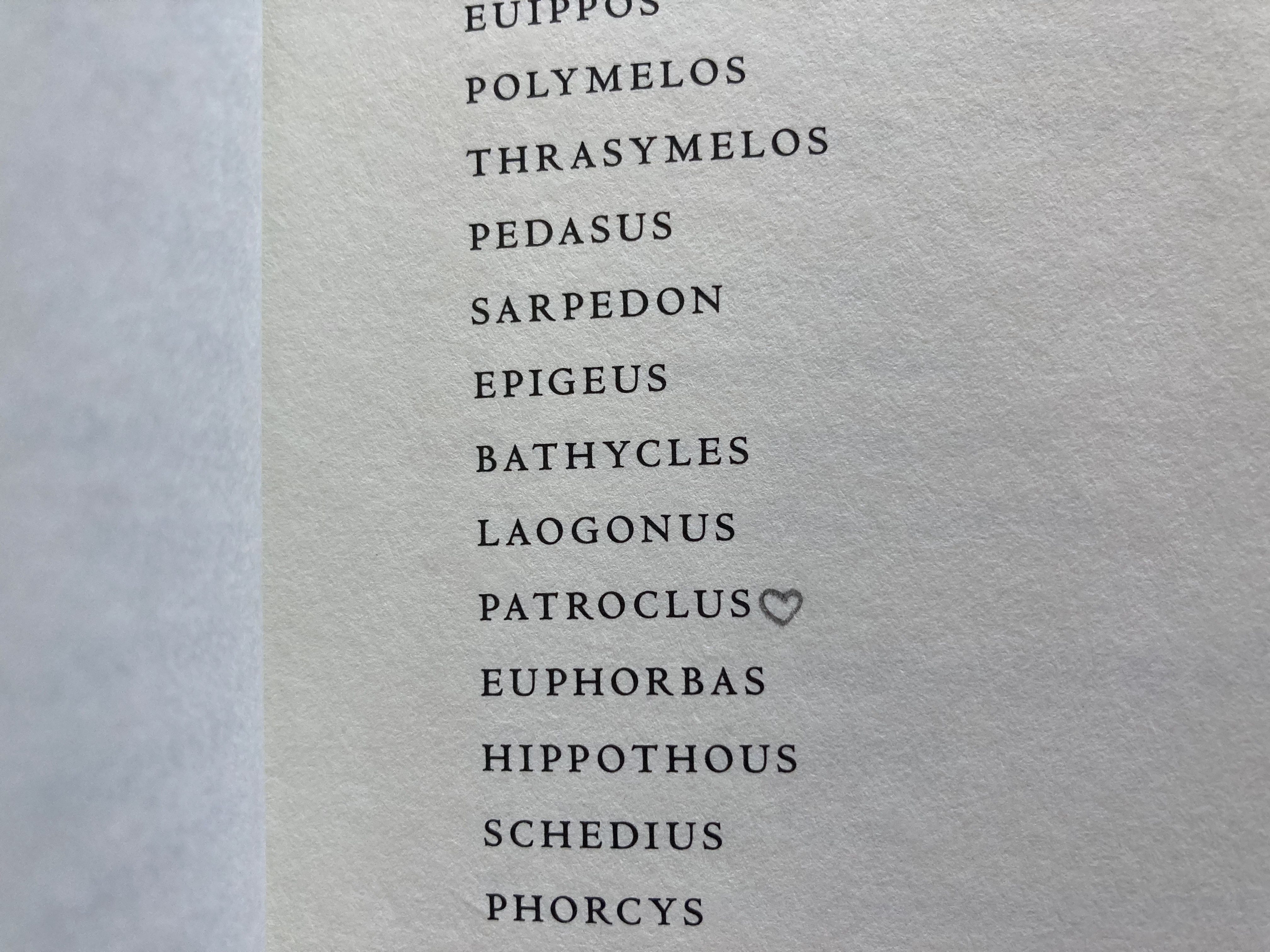
I do not know who drew this heart. I don’t know why they drew it. I know that according to the Homeric tradition and Oswald’s poem, as a child Patroclus accidentally killed another child and was sent away. I know that he was friends with Achilles. I read in Memorial that
In the mess of war he forgot his instructions
He kept killing and killing
Until the crack of his spear splintering
And the hush of his helmet spinning through the air
And the rare and immediate light
Of Apollo with one hand
Stopped him
I wonder about who drew this heart. Did they love something of Patroclus? Did they see something in his character beyond the “killing and killing”? Did they perhaps just love his name? Or did they know something more of his story, see something more than his capacity to kill? Did they wish there were another way Apollo might have stopped him?
V.
Ideas emerge out of embodied life. Moral courage has to be incarnated—translated into the meat of living, into the bones and flesh of action. I have written this essay on a day marked by meetings and laundry and shifting medical appointments undertaken in a deep freeze: the high today in Saskatchewan was -20 Fahrenheit. I have stretched my medium-aching back. I have stood over the sink and eat a pear, the juice dripping down my wrist, while I looked out at the snow. I have tried to meet my students with compassionate attention. I have checked in with a dear friend preparing for a funeral.
This week, other dear friends have been present among clergy members in Minneapolis, where more than 600 faith leaders have arrived in an echo of Martin Luther King, Jr.’s call to Selma in 1965. They are praying and singing together and calling the government to abolish ICE, and something like 100 of them have been arrested at a peaceful protest while they voiced their longings in the Lord’s Prayer. They are speaking fierce hope to each other’s hearts and ours, along with so many others gathered in protest, so many others caring tangibly and bravely for their neighbours, telling the harsh truth and nevertheless singing. They know the bright unbearable reality that so very much is wrong—and that we could be so very good to each other.
Still, some people hear the call to abolish ICE as a kind of violence, whether folks call for this abolition in angry shouts or kneeling prayers or brass-band singalongs. I think those who hear violence in this call do so because of the general atmosphere of violence, the way force has overtaken so much. They hear “abolish ICE” and they feel a threat, a counterforce, even a warning of harm to the institution’s agents.
But I hear the call to abolish ICE as a call to love. It is first and foremost a call to love people who have been terrorized by a force emboldened to occupy their neighborhoods, racially profile them, and wreak violent devastation on their lives in a manner far outside the lines of protected civil liberties. It is a call to dismantle a program of government-sponsored oppression that is fuelled by lies told at the highest level of elected official in the United States and predicated on fear of others. It’s a call for a reality in which everyone can safely go to the store for their potatoes, slice and roast them, salt them, gather their loved ones around the table, and eat.
But crucially, understood with Weil, abolishing ICE would also be an act of love not only for those ICE targets but also for its agents, who are swept away, blinded, and deformed by their roles working for this institution. It would offer them freedom from a violent project that is larger than they are, a power that overpowers them, turning them into things, as Weil says, tools of an order that does not in fact care about them in the end.
This is not to absolve individual responsibility: those who actively harm their neighbours should be held to account, and ICE agents have chosen to work these jobs. They could quit in protest at any time, as other government workers have done. But to demand the end of ICE is to recognize that the most loving change we could pray and work for would be a change to the system that empowers these “violent smiling men” of whom God has surely had enough but whom God surely nevertheless loves. It is entirely possible other people love these ICE agents too—it’s possible others have drawn hearts by their names, even, and while that love is a mystery to me, it is a reminder that the only way out of the ravages of force, according to Weil, is to decline to use it against others, to turn away from hate, even in our hearts.
The only way out of a culture of normalized violence is to bravely, probably tremulously, see the full and childlike vulnerability at the core of every person, see that they are some mother’s child, too, some loved and fallible and impermanent person. I need to keep returning to this truth, keep my heart fierce-soft, keep remembering with Oswald how it is here:
Like when god throws a star
And everyone looks up
To see that whip of sparks
And then it’s gone
Thanks for sharing your wisdom and challenge with us, Cindy! I have highlighted it to the A Deacon's Musing community https://www.facebook.com/share/p/1aMMterdqK/
Thanks, Cindy. Important words!